Jaswantiben Popat
Co-founder, Lijjat Papad
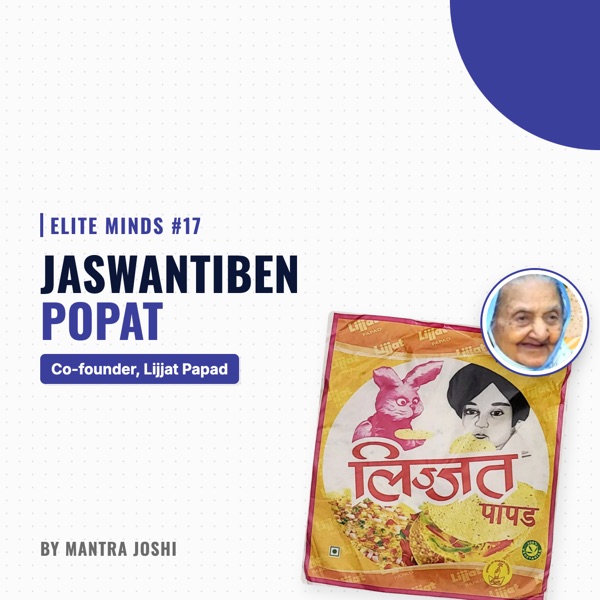
In 1959, seven women borrowed ₹80 and started a business on a terrace.
By 2019, that business was doing over ₹1,600 crore a year.
You've probably eaten what they make. You've just never heard their names.
If you think you need big money to build something big, read the story of Jaswantiben Popat.
It started on 15 March 1959, in Girgaum, South Bombay.
In an old residential building, most women were busy with their usual housework, while seven Gujarati women went up to the terrace and made 4 packets of papad.
That was day one of Lijjat Papad.
The starting money was ₹80, and even that was borrowed.
Then they made a rule that still runs the place.
No charity, no donations, no grants, even if someone offered free money.
Every rupee had to come from selling papad to real customers.
As the days went by, more and more women joined.
In 1966, the government recognised it as a village industry.
Here is how it works, even today.
Work starts at 4:30 am, and a mini bus picks the women up from near their homes.
They roll papad and are paid for what they roll.
Only women can become members, and they call each other "sister members".
Each branch's profit or loss is shared by the women who work there. Cooperative = a business owned and run by the people who work in it
Now the hard truth.
There is no fixed salary here.
If a branch makes a loss, every woman working in that branch takes home less money, because the loss is shared by all of them.
The day starts before sunrise, and the work is physical.
It is not an easy job.
But every rupee they take home is earned, not given.
And look at where it stands today.
-> 45,000 women members
-> 83 branches and 31 divisions across 16 states
-> Exports to 30+ countries
-> ₹1,600 crore+ a year by 2019, ₹80 crore of it from exports
In 2021, Jaswantiben Popat received the Padma Shri.
They started with ₹80 and have refused every free rupee for 65+ years.
✍🏻 Mantra Joshi
Spotted a wrong number or something out of date? Tell me and I'll fix it.