Deepinder Goyal
Founder, Zomato
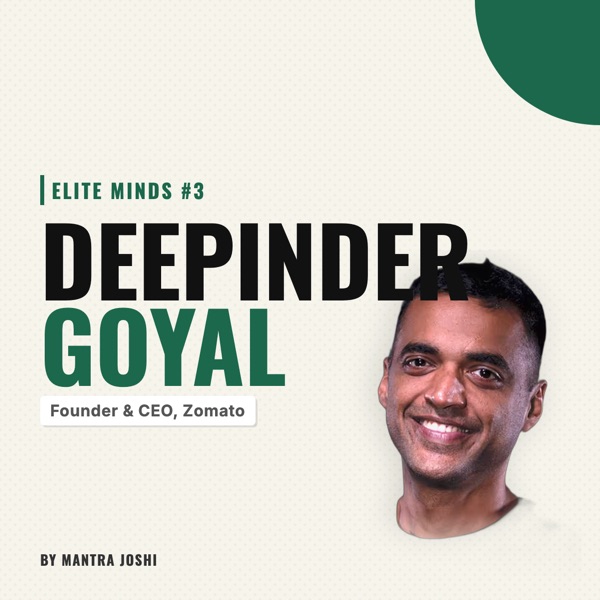
Elite Minds #3 | Deepinder Goyal
I asked Ananya Pandey who'd fit in 'Elite Minds' this Monday.
She immediately suggested Deepinder Goyal.
When I asked why, her answer was spot on.
When we think of Zomato today, what comes to mind?
Their hilarious billboards? Brilliant social media? Cute push notifications reading like texts from a friend?
Or epic billboard banter, like Zomato writing, "Gajar ka halwa bhijwa du?" and Shaadi.com replying, "Banane wali bhijwa du?"
They've built one of India's coolest, most culturally relevant brands.
But digging into the history of the man who built it blew my mind.
Today, he's a billionaire and Zomato's founder.
But his early life was marked by severe isolation.
Growing up in Punjab, he was a short kid struggling with a severe stammer.
Because speaking took so much effort, people often looked away mid-sentence. Other parents told their kids to avoid being friends with him.
Academically, he was labeled a complete failure.
In 5th grade, he flunked so badly his father had to beg the principal to let him pass.
By 11th grade, he barely scraped by with 42%.
No one expected him to make it. Not even himself.
But a bizarre 8th-grade incident changed his psychology forever.
During an exam, a teacher secretly gave him answers. Because of that, he accidentally ranked 3rd.
Suddenly, how everyone treated him changed overnight.
He realized a cold truth: the world only respects results.
He forced himself to adapt, changed study habits, cracked IIT Delhi, and survived severe imposter syndrome.
But success didn't come immediately.
After graduating, he launched Foodlet. It failed in 9 months because India simply wasn't ready for online food delivery.
He took a consulting job at Bain & Company, but his entrepreneurial itch never left.
That's where he noticed a massive everyday inefficiency.
Every day, highly-paid colleagues stood in long lines in the office cafeteria.
Not waiting for food, but just to look at a single physical menu card to place a phone order.
It was a massive waste of time.
So, he gathered menu cards, scanned them, and uploaded them to the company's internal network.
That simple website ended up crashing because so many employees tried to use it at once.
He knew he'd struck gold.
Using lessons from his first failure, he launched 'Foodiebay' in 2008.
He later renamed it Zomato to avoid getting sued by eBay and expand globally.
But the road to billions wasn't a fairy tale.
For 13 excruciating years, Zomato operated without making a single rupee of annual profit.
Facing brutal cash burns, Deepinder admitted the company almost ran out of money and died at least six times.
But he leaned on a simple philosophy: "Because I wasn't supposed to make it, any problem I face today is manageable."
He refused to quit.
Today, Zomato isn't just an app. It's a lifeline for millions and a massive ecosystem.
✍🏻 Mantra Joshi
Spotted a wrong number or something out of date? Tell me and I'll fix it.